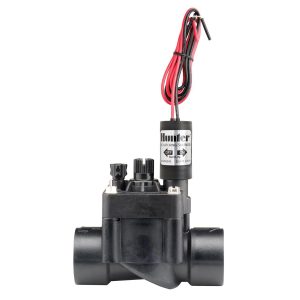
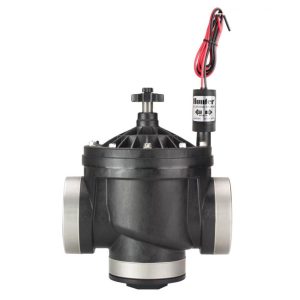
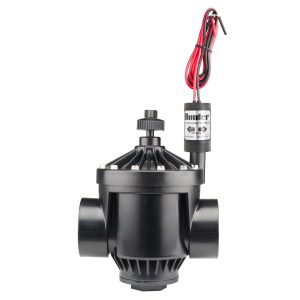
Perhaps we would be right if we said that Hunter solenoid valves are currently the best soleniod valves in the world. Their insane quality, very long lifespan, and very reasonable price make us recommend American Hunter solenoid valves as the number 1 to smart irrigation activists and enthusiasts. Of course, solenoid valves from companies such as Rainbird (USA), Orbit (USA), and a number of other famous and reputable companies in the world can fully compete with Hunter valves in terms of quality. But when you have to introduce only one company as the best company in this field, you must add other factors such as variety in models and availability in the market to the quality factor. Hunter is the first in the world in all these fields. Perhaps it would be a good idea to get to know the American company Hunter more.
Hunter Industries is a manufacturer of irrigation equipment for green spaces and lawns, as well as outdoor lighting equipment, located in San Marcos, California, USA. Hunter’s irrigation product line includes high-quality rotary nozzles, pop-up rotors, spray sprinklers, valves, controllers, drip systems and weather sensors. With more than 2,000 employees and branches nationwide in different regions and countries, Hunter is a true leader in the field of irrigation products, especially smart irrigation. For more information, please visit Hunter’s Wikipedia page or Visit the official Hunter Company website.

American Hunter solenoid valves are produced and marketed in three series: PGV, ICV, and IBV. Of these three series, PGV valves are the most famous and practical. The IBM series is all-metal and, of course, expensive. The ICV series is also not metal, but it is designed for high-pressure conditions that require high strength and is still expensive. Among them, PGV valves, which are essentially the standard valves used in conventional irrigation systems, are the most famous and best-selling solenoid valves of Hunter.
All PGV series valves, whether used with a 24V solenoid or a 9V solenoid, can withstand a maximum of 10 bar of water pressure. Or in other words, 1000 kPa. Currently, the maximum common urban water pressure in distribution networks is 6 or 8 bar and in buildings 3 to 4 bar. And this means three times more tolerance than what is in buildings and beyond what is even in distribution networks! Of course, if you plan to use these valves for irrigation systems outside the city or special irrigation systems with very high pressure and flow, you must be aware of the water pressure at the valve installation site before taking any action.
American Hunter solenoid valves have a screw on the top of the valve that can be used to increase or decrease the flow rate of water passing through the valve. This feature is useful in many cases and eliminates the need to install a separate valve to adjust the flow of water from the valve. Of course, Hunter also produces a version without a flow control screw for 1-inch models only. The current product we are reviewing is 1-1/2 inches and is only produced with a flow control screw on top.
PGV series valves are produced in three sizes: 1 inch, 1-1/2 inches and 2 inches. All models have the same solenoid. Even the water pressure tolerance is the same in all of them. So the only difference is their size. Depending on the diameter of the pipe used in the garden or the type of design of the tree watering system, each size may be the right choice for that system. Another important point that we should pay attention to is that the water flow rate through the valves is not related to their diameter ratio, but almost to the second power of the ratio of the diameters of the valves. Of course, all colleagues know this. In summary, the maximum water flow rate that can be passed through a 1 inch valve is 150 liters per minute. For a 1-1/2 inch valve, this number is 450, and for a 2 inch valve, the maximum flow rate that can be passed is 570 liters per minute. As you can see, each 2 inch Hunter valve can pass about 4 times as much water as a 1 inch valve. In general, it is not that 1-inch valves are used less in large gardens or stadiums. Rather, it depends on the type of irrigation system design. For example, an engineer designing an irrigation system for a sports field may use 8 pcs of 1-inch valves in his design, while another engineer may use 2 pcs of 2-inch valves for the same sports field.

The vast majority of Hunter products are manufactured in China, like other companies. But in the case of electric valves, the phrase “Made in Mexico” is often seen. This certainly applies to imported Smart Irrigation™ valves, and we always see the phrase “Made in Mexico.” So it seems that a large part of Hunter solenoid valves are manufactured in Mexico. But does it really matter or is the originality of the product really important? We completely agree with the latter. The idea that because this Hunter PGV-151-DC valve is made in the Mexico, and other Hunter PGV-151-DC valve is made in China, and I have to pay more for this model that is made in the Mexico, has only one disadvantage. And that is a higher cost for nothing! If we see a product from a reputable global company with two different model numbers, we can follow up with the manufacturer to find out about their differences, but when both the model and the model number are exactly the same, it means that Hunter is producing a product with the same quality.
The PGV series 9V solenoid valves are all supplied with a Hunter 9-volt solenoid and are fully compatible with all Hunter battery-powered irrigation controllers. Both the Hunter Node series battery-powered controllers and the Hunter Node-BT series battery-powered controllers all have a 9-volt output and are fully compatible with this solenoid valve.